Legal Operations Intelligence
The New Mandate for Legal Operations

Key takeaways
- AI is the defining force on the corporate legal department, and legal operating models are realigning to take advantage of the new capabilities.
- Chief legal officers plan to hold headcount and change the work. In ACC's 2026 survey, 63% expect stable headcount as roles evolve around AI.
- Legal can become an impediment to the business. Business teams need the flexibility to manage certain legal-related activities and risks themselves, provided they are clearly understood and scoped, and inside guardrails the department sets.
- Alternative legal service providers and AI-native firms are resetting the economics of outside counsel, which is impacting when and what type of work is outsourced.
- Legal operations is the facilitator and catalyst for redesigning how legal work is delivered, building the processes, tools, and information these decisions require.
- Actionable information is critical to making these service delivery decisions: business impact, risk level, cost, timing, required skills, and resource availability are key signals that must be read into the decision process.
The mandate of legal operations is evolving rapidly. Driven by the AI imperative, general counsel and their departments are reimagining how legal services are delivered. The pressure is universal. In ACC's 2026 Chief Legal Officers Survey, 47% of chief legal officers say technology and AI proficiency is the capability their CEO most wants them to develop, and Harbor's 2026 Legal Department Maturity Index finds AI implemented or under exploration at 98% of departments. Yet AI reaches further than a tool deployment. It is reshaping the general counsel's role, the department's size and skills, and the delivery model itself. Harbor's verdict is that this rethinking has lagged the deployment: "Technology is in place. The operating model has not kept up."
Two further shifts raise the stakes. First, departments increasingly acknowledge that legal review can become an impediment to the business. Business teams need the flexibility to manage certain legal-related activities and risks themselves, provided they are clearly understood and scoped. Second, alternative legal service providers and AI-native firms are resetting the economics of outside counsel. Budget and resource constraints are nothing new. What has changed is that the department can now meet those constraints by redesigning legal service delivery rather than rationing lawyers' time. That redesign turns on one decision, made request by request: which work belongs with an in-house lawyer, which with the business under defined guardrails, which with an AI-assisted workflow, and which with an outside provider. Legal operations is the facilitator and catalyst for that decision, building the processes, tools, and information the department needs to make it well and consistently.
Legal operations is well equipped to meet this moment. In the Thomson Reuters Institute's 2025 Legal Department Operations Index, drawn from a July 2025 survey of 128 US respondents, 82% reported at least one dedicated legal operations role, and the report found the work "expanding beyond its origins as primarily a cost-control function to include a focus on systems, processes, and technology." In our earlier article, Legal Ops Is Not IT for Lawyers, we discussed the interplay of the administrative versus strategic role of legal operations. This article sets out how these new forces are driving an expanded and critically important mandate for legal operations.
Legal operations frameworks are due for a fundamental rethink
Well-established frameworks are being outpaced by a rapidly changing legal environment. The CLOC Core 12 and the ACC Legal Operations Maturity Model, the profession's shared frameworks for the function, predate the impact AI is having on legal operating models. Both remain a useful common vocabulary. Both, however, frame legal service delivery as the work of the law department and its outside counsel: a department that receives legal work and either performs it or sends it out. They say less about the shifting role of the business in handling certain legal-related activities itself, or about a department that decides where each request should go.
The differences are most visible where practice has moved fastest:
- Intake and the legal front door. Neither framework treats request intake as a core function. Where intake and triage appear, they appear as markers of maturity within other functions.
- Business self-service. Self-service is largely absent, surfacing only as an advanced-stage aspiration for contract management.
- Knowledge management. Both frameworks define knowledge management for people searching for documents, not for AI systems drawing on them.
- AI. AI itself appears rarely, and only at the most advanced stage of maturity.
None of this is a failure of the frameworks. Each records the practice as it stood when it was written, and the differences show how far the practice has moved since. Our earlier article, From Reactive to Predictive, maps the frameworks against the maturity question in detail.
AI is redefining the department's people and roles
The clearest evidence of the shift is in how chief legal officers plan to staff their departments. ACC published the key findings of its 2026 Chief Legal Officers Survey in January 2026, drawn from 1,049 participants in 43 countries. In it, 63% of chief legal officers expect headcount to remain stable, a finding the association published under the heading "AI Adoption Targets Role Evolution Over Headcount Reduction". The priority placed on technological fluency for department lawyers rose 17 points to 34% in a single year. These are statements of intent rather than hiring records, but they show a clear plan to hold the size of the department and change the work its people do.
The constraint around that plan is familiar. CLOC's 2026 State of the Industry Report, released on March 2, 2026, draws on the 2025 Harbor Law Department Survey of 135 law departments with a median revenue of $13 billion. It reports workload growth driven by regulatory compliance at 63% of departments and by cybersecurity at 58%. Expectations for resources moved the other way: 37% expect outside counsel spend to increase, against 58% a year earlier, and 32% expect attorney headcount to increase, against 42%. Oyango Snell, CLOC's President and CEO, summarized it: "Demand is accelerating in areas like regulatory compliance and cybersecurity, yet budget and staffing growth are not keeping pace." ACC names budget and resource constraints as the top barrier for chief legal officers, cited by 35%.
Budget pressure is not new, but the options for responding to it are. A department that once could only ration its lawyers' time can now redesign which work requires a lawyer at all, and that redesign changes the roles the department needs. Kevin Clem of Harbor names talent alongside technology, workflows, and governance as the elements a department now has to align. Law360 Pulse reported on June 8, 2026 that legal engineers are appearing inside legal operations teams.
Visibility and insight strengthen the partnership between legal and the business
AI has also changed what the general counsel is expected to lead. In the ACC survey, a record 84% of chief legal officers report directly to the CEO, 79% "almost always" attend board meetings, and 74% provide proactive strategic counsel rather than answering questions as they arrive. ACC describes chief legal officers as mandated to lead their departments' adoption of AI. As the remit of the general counsel and the legal department broadens and their involvement in the business deepens, legal has to run more like a business itself.
General counsel, their departments, and legal operations increasingly recognize that being visible to the business is an important part of the job. The Thomson Reuters Institute's 2026 State of the Corporate Law Department, published on March 24, 2026 and drawn from more than 2,300 interviews, shows why. It found that 86% of general counsel see legal as a significant contributor to business objectives, while 17% of C-suite respondents agreed and 42% said legal contributes "a little" or "not at all". The two figures come from different populations, so they measure a gap in perception rather than in contribution. The gap still matters: if the business does not recognize the value the law department provides, it is less likely to support the department's budget and resource needs.
Visibility also works in the other direction. Legal is too often brought in after the decisions that shape a risk have been made, when issues it could have identified and addressed early have become harder and costlier to resolve. That is beginning to change. ACC found that "legal expertise is now integrated into business planning during the inception of projects rather than at the point of crisis". Business teams engage with legal more readily when the interaction is streamlined, and technology is reducing the friction: a single front door for requests, guided intake, and shared workflows make it easier for the business to involve legal early and for legal to see what the business is planning.
Transparency and insight are what sustain that partnership. The Thomson Reuters report records technology rising as a strategic priority for general counsel from 14% to 28% in a year, with 86% of those mentions referring to AI, while very few departments collect success metrics for AI or link its use to business outcomes. Its advice is to "institute metrics for success that translate to the rest of the business". That is legal operations work: choosing the measures, producing them on a schedule, and presenting them in the business's terms. In EY Law's 2025 General Counsel Study, published on April 9, 2025 and drawn from 1,000 general counsel and chief legal officers at companies with revenue above $1 billion, 52% reported disorganized data and 44% reported disconnected legal and business platforms. Without connected data, a department can report on individual matters but not on its work as a whole. In our previous article, Breaking the Silo Between Legal, Finance, and the Business, we discussed how departments can improve transparency and reporting to their stakeholders.
The general counsel's priorities point the same way. In the Thomson Reuters Institute's 2025 index, 47% of general counsel said they are more focused on improving legal service than on reducing its cost, and only 7% put cost reduction first. Jeff Franke's four paradigms for the general counsel, set out in the ABA Journal on July 24, 2023, end with "the general counsel who is helping to create a competitive advantage for the business", and he paired each paradigm with a legal operations role. That pairing remains relevant: the more strategic the general counsel's role, the more it depends on a capable legal operations function.
The opportunity to open the legal service delivery model
One of the most notable trends in corporate legal departments is that, driven by AI, both the business and the legal department are moving quickly to open the process for resolving legal-related activities and mitigating risk. The demand does not come from the business alone. Legal departments themselves recognize that certain low-risk legal-related activities can be handled properly by the business directly, or with minimal input from the department. Non-disclosure agreements are the example most often cited: they are high in volume, generally low in risk, and well suited to a standard template with defined fallback positions. Routine commercial contracts are close behind.
Opening the model also addresses a harder acknowledgment: legal can become an impediment. A business unit that waits in the department's queue for a standard non-disclosure agreement loses time, and a business that routinely waits learns to work around the department. The better answer is to agree in advance which activities the business can handle and on what terms, with legal still part of the decision.
The department sets the terms of that delegation. It decides which work the business may complete on its own, which positions the business may accept, at what threshold a request returns to a lawyer, and who approves a change to any of them. Legal operations builds what makes the delegation workable: the playbooks, the templates and forms, the workflows, the thresholds and escalation paths, and a record of which position the business took and why. That record keeps the risk under the department's management after the handover. The department's role in the work it hands over is to make sure the business understands what it is agreeing to and what the exposure is, and to work alongside it on the cases that exceed the playbook.
Much of this work runs well without AI. Established workflow and forms-based processes, such as a standard non-disclosure agreement template, a guided intake form, and a defined approval path, combined with regular collaboration between the business and legal, are often the better fit. They can also provide a self-service approach that both sides find more acceptable, because the same request produces the same result every time. AI carries a limitation of its own, and users should know it before they rely on one: probabilistic outputs can be variable, inconsistent, and inaccurate. Legal decisions often require a level of precision that is not well matched to the limitations of today's AI tools. In our earlier article, Legal AI Is Not Deterministic, we explained why that matters for any workflow expected to produce the same result twice. Self-service works best where a playbook already fixes the acceptable positions, with AI added where it improves the experience without weakening the control.
Adoption is visible but not yet well measured. Gartner's Weston Wicks has predicted that by 2029 about half of contract reviews will be delegated to self-service systems that escalate one in 10 for human attention, and that 60% of legal departments will run intake systems that use AI to capture every request and answer half of them without a person. Both are forecasts rather than measurements, but they indicate the direction.
The front door has a second value: it is the department's best source of information about its own demand. A request that arrives through a front door is counted, categorized, and timed. A request that arrives as an email to the lawyer who knows the business unit is none of those things.
The economics of outside counsel are being reset
The same redesign extends beyond the department to external providers, including outside counsel, alternative legal service providers (ALSPs), and other services. Once the department has decided how each type of work should be delivered, the largest external question is what still goes to a law firm. Most of the evidence points to less. Harbor's 2025 Law Department Survey, released on December 8, 2025 and drawn from the same 135 departments, found 76% using alternative fee arrangements, against 70% a year earlier, and 61% completing or implementing convergence on fewer firms, against 50%. Another 65% reported deliberate efforts to keep work in-house. ACC and Everlaw surveyed 657 in-house professionals in 30 countries for a report released on October 14, 2025, with Everlaw as a vendor co-sponsor. In it, 64% expected to rely less on outside counsel, naming drafting (78%), contract management (71%), and research (62%) as the work to bring in-house.
Expectations of firms have shifted with the work. In the ACC and Everlaw survey, 59% "report no GenAI savings from their law firms yet", and 24% are satisfied with their firms' adoption. Few departments have asked. In the 18th annual Law Department Operations Survey, run by the Blickstein Group with FTI Consulting among 68 companies and reported by Legal.io on December 19, 2025, fewer than one in five departments had pressed their firms to show what AI had saved. Departments that want to see AI savings will need to ask for them.
Three findings cut the other way. The Thomson Reuters Institute's 2025 index observes that, for most of the past decade, "AFAs are used in about 20% of legal matters consistently". In the 2026 Thomson Reuters report, 36% of general counsel expected to increase outside counsel spend, against 20% who planned to decrease it. And ACC reports that 48% of departments turn to outside counsel for regulatory surges, reaching for a firm when their own capacity runs out. The market is not zero-sum: in the same year a department insources drafting, it may buy more surge capacity from the same firms, because routine drafting and specialized regulatory work are different needs.
The supply side is changing faster still. AI-native law firms, built on AI business models from the start, are emerging. AI agents that perform associate-level and subject-matter specialist work are driving established firms to rethink their staffing, their business models, and their fee structures, particularly in transactional work such as commercial contracting and intellectual property. The early entrants report figures of their own, covered by the International Bar Association on December 11, 2025 and by Artificial Lawyer on March 31, 2026. Blackstone invested $50 million in Norm Law in November 2025. Crosby reports a median contract turnaround of 58 minutes. Garfield.Law was approved by the UK Solicitors Regulation Authority on May 6, 2025, and Eudia Counsel operates under Arizona's alternative business structure program. General Legal prices a standard contract review at $500 and a non-disclosure agreement at $250, a figure a department can set directly against its own cost per document.
The established alternatives are growing as well. The ALSP market was $28.5 billion as of fiscal 2023, with 18% compound annual growth, according to a January 28, 2025 report by the Thomson Reuters Institute with Georgetown Law and Oxford Saïd. Frontier model providers have entered directly: Anthropic released Claude for the legal industry on May 12, 2026, with "20+ new MCP connectors" and "12 new plugins tailored to specific legal work and practice areas".
Managing the external relationships now has three parts. The department makes a deliberate sourcing decision for each type of work, and revisits it on a schedule it sets. It states what it expects from its firms' use of AI in terms a firm can act on, such as where efficiency is expected and how the saving is shared. And it holds the data to conduct that conversation: what it spent by matter type, what it received, and how long the work took. In our earlier article, The $20B Blind Spot, we described what a department gives up when it cannot answer the second of those questions.
Knowledge curation is the foundation AI depends on
To be effective in legal work, AI needs knowledge that is specific to the company: its own playbooks, precedents, negotiated positions, and matter history, not general public sources. That knowledge also has to be accurate, current, and clearly authoritative, or the output will not reach the level of quality that legal work demands. Every delivery channel draws on the same material: a playbook tells a business unit which terms it may accept, a precedent tells an AI-assisted workflow what an acceptable clause looks like, and matter history tells a panel firm what the company has agreed to before. Keeping that material authoritative and current is an operating responsibility, and legal operations is its natural owner, as the curator of the department's knowledge and of the content its AI draws on.
Knowledge management needs to be reoriented accordingly. The frameworks define it as a practice for people. CLOC's Core 12 page on the function describes processes and standards that collect, structure, and organize knowledge; the ACC model describes capturing, distributing, and using structured and tacit knowledge assets. Either definition produces a library organized for a person who knows what to look for. The shift is toward content that is readily available to AI: structured, tagged, and organized so that a retrieval system can work through it as reliably as a person can. Which playbook is current, who approves a change to it, and how a superseded precedent is retired become operating questions, and they belong with the function that manages the operating model.
Departments are beginning to create roles for this work, often before the roles have formal titles. In the Law360 Pulse report on legal engineers, Elly Meenan, founder of The Legal Ops Job Board, observed: "From what I see, the legal engineer is already in-house. We just haven't seen the title, salary shift yet." Mary O'Carroll described the obstacle: "With these roles that are new and not well understood, it's even more challenging to get that headcount and get it approved." Practitioners are also bringing the disciplines together. At CLOC Global Institute 2026, the practitioner-led breakout on knowledge management was run jointly by legal operations and knowledge management staff from JPMorganChase and Guggenheim.
AI governance is converging on the same work. In the CLOC and Harbor data, 85% of departments have a dedicated resource or committee overseeing AI. Snell described the shift at the institute, in remarks Legal IT Insider reported on May 15, 2026: "The AI conversation has matured. Teams are now sharing what has worked, what broke, and how they are governing it." Governance and curation are closely linked: controls on what an AI system may do are of limited value if the content it draws on is out of date. In our earlier article, The AI Readiness Gap in Legal Departments, we set out what a department needs in place before an AI assistant earns its role. The cost of leaving authority unsettled is an old problem, described in Institutional Knowledge Is Walking Out the Door. The difference now is that when no one has settled which version is authoritative, an AI tool may still produce a confident answer drawn from the wrong source.
Legal operations is the catalyst and manager of the operating model
Each of the developments above comes down to a decision about the operating model. Harbor frames the next phase of maturity in the same terms. In Kevin Clem's words, "The next phase of maturity will be defined by how well organizations align technology, workflows, talent, and governance into a cohesive operating model."
In practice, the operating model is one system. A request enters through the front door and is routed to one of five channels: business self-service inside guardrails, an automated or AI-assisted workflow, an in-house lawyer, outside counsel, or an alternative provider. Legal operations manages the routing rules and the risk thresholds that decide which work goes where and when a request moves to a different channel, and it captures the data that returns from every channel (Exhibit 1).
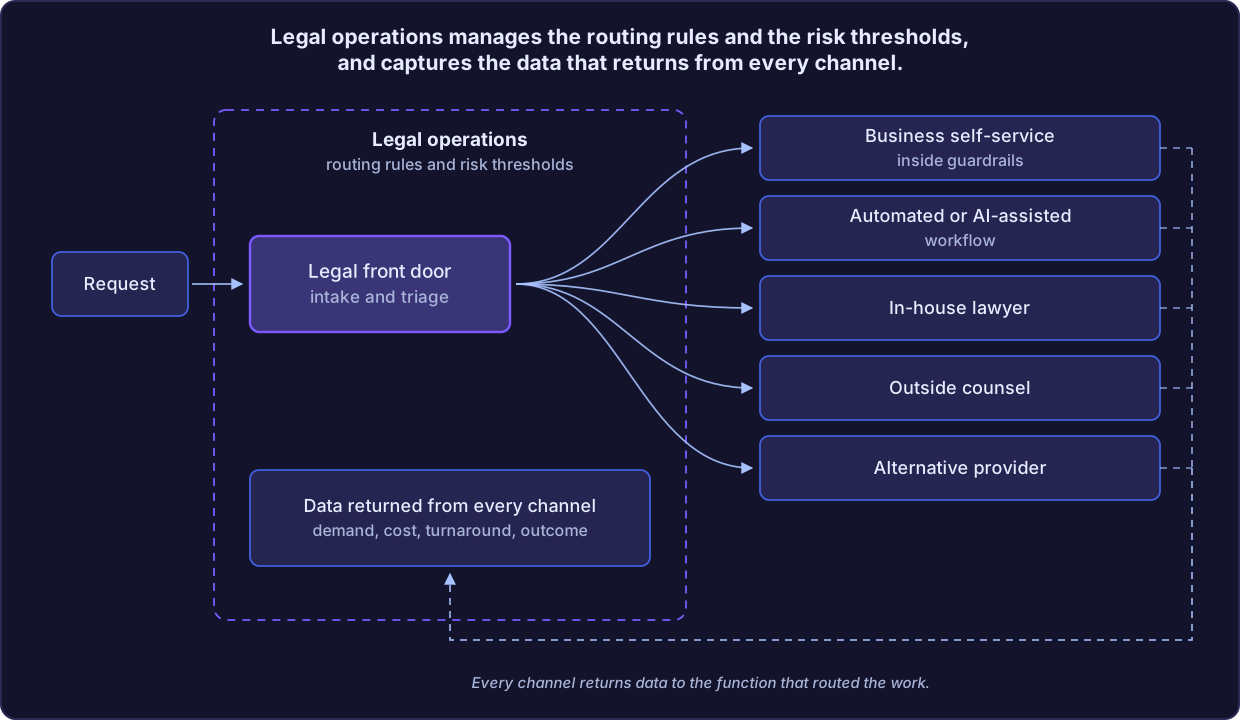
Read against that picture, the forces described above converge. AI changes which channels a department can staff and how much work can leave the lawyer's desk. Opening the delivery model to the business adds a channel on one side, and the reset of outside counsel reshapes the channels on the other. Legal operations manages that system through four capabilities:
-
Service delivery: deciding who or what performs each type of work. Consider, for example, a food delivery company that sorts its agreement types by risk. Standard vendor terms go to business self-service inside fixed guardrails, a middle tier to an AI-assisted draft with lawyer review, and agreements carrying regulatory exposure stay with the department's lawyers from the first draft. Most of the effort goes into defining the guardrails; configuring the tools is comparatively quick.
-
Sourcing: choosing external providers and revisiting those choices. Consider an online marketplace that groups a year of matters by type and cost and finds that routine regulatory filings consume a disproportionate share of one firm's billing. It moves that category to an alternative provider on a fixed fee, with an escalation path back to the firm. The analysis takes three months, because matter records and invoices have to be reconciled by hand.
-
Reporting: turning request and matter data into insight for the department and the business. Consider a property and casualty insurer with a legal team of about 200 that replaces a shared mailbox and four intake forms with a single request route. Beyond the administrative benefit, the department can report, for the first time, how many requests each business unit sends, of what kind, and how long each takes to close. The hardest step is writing the routing rules, since the department has never had to define which requests need a lawyer.
-
Knowledge management: maintaining the authoritative content every channel draws on. Consider a security software company that rewrites its non-disclosure agreement playbook as a set of positions with a stated fallback for each, then points both its self-service tool and its AI assistant at that one source. When it later changes its position on mutual indemnity, it changes it once, and the change carries to every channel.
Managing ahead of events, not only in response to them
An operating model also has to hold up when something unplanned happens. Administration keeps the department running: invoices are processed, matters opened, reports issued on schedule. Management goes further, keeping the department ready for the events nobody schedules. That readiness has two sides, before an event and after it, and both are read from the same six signals (Exhibit 2).
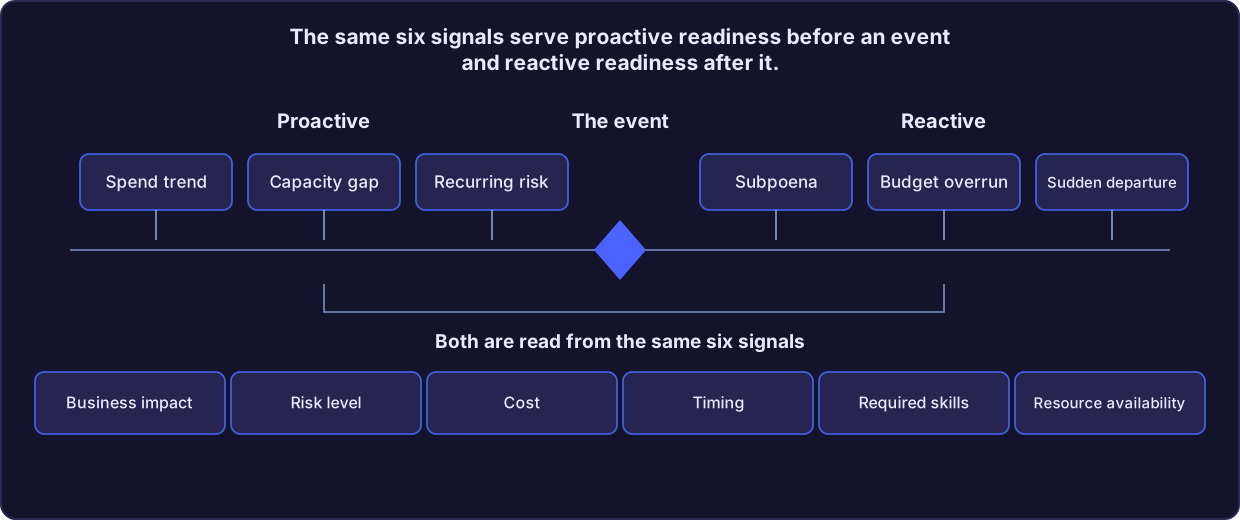
Before the event: proactive readiness. A well-managed department sees the spend trend, the capacity gap, or the recurring risk before it becomes an event, and acts while there is still time to shape the outcome. CLOC states the expectation directly: "A proactive legal ops team can anticipate and plan for challenges before they arrive."
After the event: reactive readiness. When the subpoena, the budget overrun, the regulator's letter, or the sudden departure arrives, the department has to respond from what it already knows. Each arrives with a short clock and is answered from records that either exist in usable form or do not. A department reconstructing three years of a vendor relationship from email during a litigation hold is facing the cost of poor record-keeping at the worst possible time.
The same information serves both. The signals that let a department anticipate an event and respond to one are the same signals that inform every service delivery decision: business impact, risk level, cost, timing, required skills, and resource availability. Six questions test whether a department can read them:
- Business impact. Can you show which business outcomes your legal work supports, and which requests matter most to the business? This probes whether legal's contribution can be stated in the business's terms.
- Risk level. Can you see where risk is concentrating, by business unit, agreement type, or jurisdiction, before it becomes a matter? This probes whether the department can act before the event rather than after it.
- Cost. Can you show what each type of work costs in each channel, from self-service to outside counsel, against what it returns? This probes whether sourcing decisions rest on data or on habit.
- Timing. Can you see how long each type of request takes to resolve, and where it waits? This probes whether legal is enabling the business or slowing it down.
- Required skills. For each type of work, do you know what expertise it actually requires, and whether it is receiving more or less than that? This probes whether work is matched to the right channel.
- Resource availability. Can you see capacity across your lawyers, your providers, and the business before you route new work? This probes whether the department can absorb a surge without scrambling.
In meeting these objectives, technology is necessary but not sufficient. Many departments find that their existing technology, if set up and used properly, can meet their needs. The primary challenge is information and data: deciding which records are authoritative, who keeps them current, and how they are structured so that the signals above can be read. The same information lets the department tell the business where the risk sits and where it may proceed on its own. Business teams are far more likely to follow guardrails they understand and trust.
The new mandate in practice
AI has made the redesign of legal service delivery both possible and urgent. General counsel and their departments are opening the delivery model to the business for defined, lower-risk work, resetting what they send to outside counsel and other providers, and rebuilding their knowledge so that AI can draw on it with the quality legal work demands. Each of those changes is a decision about the operating model, and each depends on the same information.
Legal operations is the facilitator, catalyst, and manager of that change: building the processes and tools behind each channel, curating the knowledge every channel draws on, and producing the insight that makes legal's contribution visible to the business. That is the new mandate. It moves legal operations from administering the department to managing how the department delivers value to the business.
For legal operations leaders, practical starting points include the following. Understand the department's demand at the front door. Define the guardrails for the low-risk work the business can handle, beginning with non-disclosure agreements and routine contracts. Make a deliberate sourcing decision for each type of work. Designate the authoritative sources of the department's knowledge and who keeps them current. And put in place the information that lets the department read business impact, risk, cost, timing, skills, and capacity before it decides.
Building that information base is the subject of the rest of this series. The next article describes the platform that brings process, people, and technology together to produce it, and the one after describes the ontology that makes the information actionable across the systems a department already runs. A fourth treats the deterministic view of the same information as a business intelligence problem, and a fifth returns to knowledge management as the context AI needs. Spaarke set out the category-level argument that the series continues in What Is Legal Operations Intelligence?.
Sources
- Association of Corporate Counsel, 2026 Chief Legal Officers Survey
- Harbor, 2026 Legal Department Maturity Index
- Thomson Reuters Institute, 2025 Legal Department Operations Index
- CLOC, 2026 State of the Industry Report
- Law360 Pulse, AI Boom Gives Rise To In-House Legal Engineers
- Thomson Reuters Institute, 2026 State of the Corporate Law Department
- EY Law, 2025 General Counsel Study
- Gartner, Weston Wicks on AI-enabled intake and contract review
- Harbor, 2025 Law Department Survey
- Association of Corporate Counsel and Everlaw, 2025 in-house survey
- International Bar Association, The AI-native law firm
- Thomson Reuters Institute with Georgetown Law and Oxford Said, Alternative Legal Service Providers 2025
- CLOC, 2026 CLOC Global Institute
- Legal IT Insider, CLOC Global Institute 2026: A Market in Transition
Related reading:
- Legal Ops Is Not IT for Lawyers
- From Reactive to Predictive: How LOI Aligns with Legal Operations Maturity
For questions or comments about this article, contact Ralph Schroeder, Founder and CEO of Spaarke, at ralph.schroeder@spaarke.com, or visit spaarke.com.
Continue reading



Want to see how it works?
Get access